

Sexclusivity is an informal portmanteau, not a relationship status with one agreed definition. People may use it to mean “we will not have sex with other people,” even while the relationship is still undefined. Some dating coaches use the same word for a personal rule: waiting to have sex until both people have agreed they are in a relationship. Those meanings overlap in some conversations and differ in others. If someone says “sexclusivity,” ask what they mean before relying on the label.
The distinction matters because sexual exclusivity, dating exclusivity, and being official are three decisions. A short, direct conversation can define which one you are making. If you want a second read on a message exchange after you have clarified the agreement, What Brandon Thinks can organize visible chat patterns; you can start a private chat report or return to What Brandon Thinks home when that would help. A transcript still cannot reveal private intentions or prove what happened offline.
What does sexclusivity mean?
Sexclusivity can point to a boundary around sexual partners, but people use the exact term differently. One person may mean that neither partner has sex with anyone else. Another may mean they will personally wait to have sex until a relationship label is agreed. A third may use it as shorthand for a broader commitment that includes dating and sex.
That variation is why searching for a dictionary-style definition does not settle a private conversation. The term appears in user-generated definitions, dating-coach advice, and discussions about relationship boundaries, with meanings that are not fully consistent. The useful question is not “Which stranger has the official definition?” It is “What are we each agreeing to do?”
The word itself does not establish a promise. It does not automatically mean you are partners, that dating apps are paused, that every kind of sexual contact is included, or that an agreement has been discussed at all. Treat it as a prompt to define the boundary, not as a substitute for defining it.
Three agreements people often collapse into one
People often use “exclusive” to cover multiple expectations. The American Sexual Health Association describes how dating and relationship labels can mean different things to different people. Separate the decisions before you decide whether they fit you:
- Sexual exclusivity: whether either person will have sexual contact with other people, and what each person means by sexual contact.
- Dating exclusivity: whether either person is still going on dates, matching, flirting, or actively pursuing other romantic connections.
- Relationship status: whether both people want to call the connection a relationship and what that label means to them.
The categories can be combined, kept separate, or left undecided. For example, two people might agree not to have sex with other people while continuing to date casually. They might decide to stop dating others but wait before using a boyfriend/girlfriend or partner label. Or they might want a relationship and agree on sexual exclusivity at the same time. There is no universal sequence that every couple must follow.

When you want a specific answer, ask about the behavior instead of testing a label. “Are we exclusive?” can invite two different definitions. “Are either of us still going on dates or having sexual contact with anyone else?” gives both people more to respond to.
Why the word creates confusion
“Sexclusivity” has been used in at least two distinct ways in public dating advice. Some coaches use it to mean that a person should wait to have sex until the other person has agreed to a defined relationship. Other everyday discussions use it to describe an agreement to have sex with only one person, while leaving dating or the relationship label open. A psychotherapist writing about dating at midlife has also described a “sexclusivity rule” as an externally imposed rule that may not suit everyone.
These are descriptions of how different writers use the term, not evidence that one script is right for every reader. A boundary can be useful when it reflects what you want. It becomes less useful when it is treated as a tactic to make someone commit, a test they must pass, or a universal rule about when sex should happen.
Your own boundary can be simple: “I only want sex in a relationship,” “I want us to stop seeing other people before we have sex,” or “I am comfortable with sex while we are still deciding what this is.” The important part is that the statement describes your choice clearly and leaves the other person free to decide whether the same arrangement works for them.
What to clarify before you agree
You do not need a contract or a perfect speech. You do need enough detail to understand the choice you are making. Consider these prompts, then keep the conversation to the parts that matter to you:
- What does “sex” include for each of us? People may mean different acts or kinds of contact. Name the scope that matters to you rather than assuming the other person shares your definition.
- Does the agreement include dating? Ask whether either person will keep going on dates, matching with people, or pursuing other connections.
- What about existing partners or ongoing conversations? If someone is already seeing or speaking with another person, decide what disclosure and transition would look like.
- When does the boundary begin? “Starting now,” “after our conversation,” and “once we use a relationship label” are different timelines.
- What safer-sex choices are part of the agreement? Discuss barriers, testing, and relevant health information separately. A label does not answer those questions.
- How will we handle a change? Agree to talk before either person changes the arrangement, and to disclose a change that affects the other person’s informed choices.
- When should we revisit this? A check-in after a few weeks, a change in dating plans, or a change in health circumstances can keep an old assumption from becoming a new conflict.
If one of you does not know yet, “not yet” is useful information. You can decide whether to pause sex, keep seeing each other with a different boundary, or take time to think. A clear answer about uncertainty gives you more to work with than a vague “we’ll see” that quietly means different things to each person.
A low-pressure way to start the conversation
Choose a calm moment when neither person is trying to get an immediate yes to sex. State your own preference, ask what the other person means, and make room for a real answer. Here are five scripts you can adapt rather than repeat word for word.
If you want to define sexual exclusivity
I like where this is going, and I want to check that we mean the same thing by sexual exclusivity. For me, it means neither of us has sexual contact with someone else while we are doing this. How do you understand it?
If you want to separate dating from sex
When we say we are not sleeping with other people, are we also agreeing not to date or message new people? I am okay deciding those separately, but I want us both to know what we are choosing.
If your boundary is to wait for a relationship
I am attracted to you. I only want to have sex once we have both decided we are in a relationship. That is what feels right for me; you do not have to want the same thing.
If you want to talk about sexual health
Before we change how we use protection, can we talk about when we were last tested, what protection we want to use, and whether either of us has other partners? I would rather make that choice with the full picture.
If the agreement needs to change
I want to revisit what we agreed to. My situation or what I want has changed, and I want to talk before anything changes in practice. Can we work out what feels fair and safe for both of us?

After you ask, listen for the exact words. If you hear “I’m not sleeping with anyone else right now,” follow up with whether they are agreeing not to in the future, whether they are dating other people, and when the agreement starts. “Right now” describes a current fact; it may not be a future agreement.
Sexual exclusivity is not a sexual-health plan
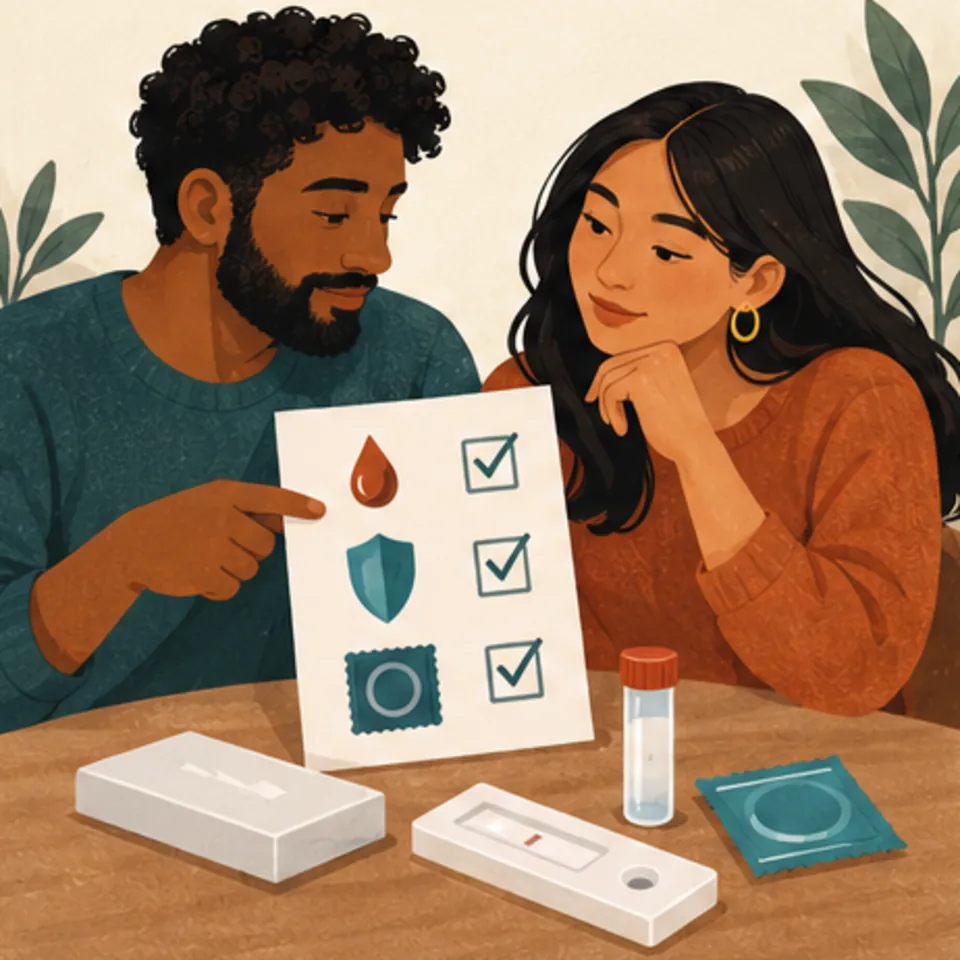
An agreement about partners can matter to sexual health, but it does not replace a health conversation. People can have different testing histories, infections may have no symptoms, and an exclusivity agreement cannot verify conduct outside the conversation. A negative result also relates to particular tests and timing; a clinician can help determine what tests make sense for each person.
Before changing condom or barrier use, talk about recent testing, relevant exposure, contraception where applicable, and what protection you want to use. Be clear about what you know and what you do not know. You can suggest getting tested together without framing the request as an accusation. If either of you has questions about symptoms, test timing, treatment, or individual risk, ask a qualified healthcare professional.
No one owes sex because they agreed to exclusivity. No one owes exclusivity because they had sex. Consent applies to each choice and can be withdrawn. A person may ask for a particular arrangement, and the other person may decline; the next step is to decide whether the arrangement still works for you, not to pressure someone into it.
What relationship research tells you, and where it stops
One Australian study of 5,323 people in ongoing heterosexual relationships found that, in that survey, most respondents expected sexual exclusivity, while fewer reported having explicitly discussed and agreed on it. The survey began in 2004–05 and followed respondents a year later. It is a specific, older sample and does not provide a current estimate for every country, age group, orientation, or dating situation.
The narrower lesson is practical: expecting the same thing and saying the same thing are not identical. Some people infer exclusivity from a relationship label, sex, frequency of dates, or a partner’s behavior. Someone else may treat the boundary as unspoken until it is named. Asking directly removes one source of ambiguity, even though it cannot guarantee agreement or trustworthiness.
A separate 2019 study of 160 male couples in Atlanta, Boston, and Chicago found weak agreement between partners about whether they had a mutual sexual agreement. Even when both partners said they had an agreement, their accounts did not always match on its details. That study covered a specific group and cannot describe every relationship. It does illustrate why agreement on a broad label does not guarantee agreement on each rule.
Community discussions about sexual exclusivity show the same range of personal interpretations. In one thread, commenters disagreed about whether agreeing not to sleep with others also meant stopping dates. In another, people described both arrangements: sexual exclusivity while continuing to date, and dating exclusivity without an official label. Those posts are individual accounts, not a representative poll. They are useful as examples of why it is safer to clarify than to rely on a claimed majority.
What a text exchange can show
A written exchange can preserve a direct question, a direct answer, a stated date, or a later message that changes the agreement. It can help you revisit what was actually said. It is weaker evidence when the wording is vague, the conversation is incomplete, or the two people use “exclusive” differently.
Look at the messages around the sentence, not only the sentence that worries you. Was the person answering the same question you asked? Did either of you define “exclusive”? Was the answer about what was happening that day or what would happen going forward? Did someone later say the arrangement had changed?
Even a clear text cannot prove private intent or offline conduct. A short delay, an emoji, an active profile, or a change in tone does not establish that someone broke an agreement. Ask for context and compare the answer with observable behavior over time. If the uncertainty is affecting your health or safety, use support from a qualified person who can understand the full situation.
The WhatsApp chat analyzer and iMessage chat analyzer organize supported exports for recurring communication patterns and exact excerpts. You can explore the free preview or use the friend and group chat guide for a conversation involving several people. It cannot verify private behavior, read a person’s mind, or decide whether an agreement was honored. If you use a chat tool, treat its output as an index to inspect, not a verdict. You can read the relationship analysis overview, see a fictional sample report, compare What Brandon Thinks alternatives, or review privacy and evidence limits first.

How to revisit the agreement
An agreement is a snapshot of what two people said they wanted at a particular time. If the relationship changes, the agreement may need to change too. A new partner, a change in protection, a shift in whether you are dating other people, or one person wanting a different relationship label can all be reasons to check in.
Use a small review rather than waiting for a conflict to force the conversation:
- Repeat the agreement as you currently understand it.
- Say what has changed, without leading with blame.
- Ask whether the same boundary still works for both people.
- Agree on what happens next and when it begins.
- If you cannot agree, pause the affected activity while each person decides what they are comfortable with.

Revisiting is not proof the first agreement failed. It is how people update a decision when the facts, feelings, or circumstances change. Both people can ask for a change; neither person can unilaterally redefine the agreement and expect the other person to have consented to the new version.
Common assumptions to replace with a question
“We are sexually exclusive, so we must be officially together.” Maybe you both mean that, but the label does not follow automatically. Ask whether you are defining the relationship too.
“They said they were not sleeping with anyone else, so they promised they never would.” That could have been a statement about the present, a future commitment, or an incomplete answer. Clarify the timeframe and whether it is an agreement.
“If they wanted exclusivity, they would know what I mean.” People can share a goal and differ on the boundaries, timing, or label. A direct question helps you learn whether the difference is small or important.
“If I ask, I will sound needy or controlling.” Asking about a boundary does not control another person. You can state what you want for your own participation and accept that the other person can choose differently.
“Exclusivity means we can stop talking about testing.” Keep health choices explicit, including testing and protection. For personal medical decisions, speak with a healthcare professional.
“A screenshot proves what happened.” A screenshot may preserve words; it does not establish the full context or offline conduct. Ask, review the surrounding messages, and avoid turning an ambiguous line into certainty.
Frequently asked questions
Is sexclusivity a real word?
It is an informal word people use in dating conversations, but there is no single standardized relationship definition that settles what every speaker means. Define the agreement in plain language.
Does sexual exclusivity mean we stop using dating apps?
Not automatically. Some people include app use and dating in exclusivity; others mean only that they will not have sex with other people. Ask about dates, matches, messages, and whether either person is actively pursuing other connections.
Can you be sexually exclusive without being boyfriend and girlfriend?
Yes, if both people understand and agree to that arrangement. A sexual boundary, dating exclusivity, and a relationship label can be separate choices. Say which ones you are making and what they mean to each of you.
How soon should I ask?
There is no universal number of dates. Ask before making a choice that depends on the answer, especially before changing protection or assuming a new boundary. You can start with what you want and invite the other person’s view.
What if one person wants exclusivity and the other does not?
Neither person has to adopt the other’s preference. Take the answer seriously and decide whether you want to continue under the arrangement offered. Do not use sex, silence, or pressure to force a commitment.
Can a chat analyzer tell me whether we agreed to be exclusive?
A chat analyzer can surface exact messages and recurring patterns in an uploaded transcript, but it cannot decide what a person privately intended or verify offline behavior. Use the original conversation and ask the other person to clarify.
Make the agreement specific enough to choose
The safest meaning of “sexclusivity” is the meaning both people have actually discussed. Separate the boundary around sex from the choice to date other people or use a relationship label. Include timing, sexual-health conversations, disclosure, and a way to revisit the decision. If the answer is still unclear, you are allowed to wait before acting on an assumption.
If a written conversation is part of what you are trying to understand, review how What Brandon Thinks handles relationship chats and its privacy and evidence boundaries. When you are ready, start with the free chat preview, or return to What Brandon Thinks to compare the other ways to analyze a conversation.